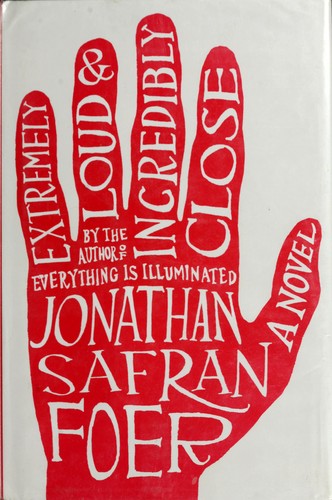
Extremely Loud and Incredibly Close
Nine-year-old Oskar Schell searches New York for the lock that fits a mysterious key left by his father, who died on September 11.
Mood Emotional
Pacing Balanced
Complexity Dense & Rewarding
Nine-year-old Oskar Schell searches New York for the lock that fits a mysterious key left by his father, who died on September 11.
About This Book
A nine-year-old boy who lost his father in the September 11 attacks finds a mysterious key among his father's things and roams New York searching for the lock it opens, a quest that is really an attempt to hold on to a parent the world took without explanation. Foer writes grief through the voice of a precocious, anxious, grieving child, and the book's formal inventiveness, photographs, blank pages, colored text, typographic experiments, is an attempt to render an experience that ordinary prose can't contain. Woven through Oskar's search is a second story, his grandparents' survival of the Dresden firebombing, linking two catastrophes across generations. The tone is emotional and the pacing varied, the child's narration by turns funny, exhausting, and heartbreaking. This is a book for readers who are open to formal experiment in the service of feeling, who want fiction that engages the emotional aftermath of catastrophe rather than the event itself, and who can tolerate a narrator whose grief expresses itself as relentless, quirky over-articulation. Readers who find precocious child narrators grating, or who distrust formal gimmickry, will have their reservations tested; the book divides readers sharply on exactly these grounds, and the divide is real. What its admirers value is the ambition to find a form adequate to a grief with no precedent, and the moments when the experiment breaks through to genuine devastation. Whether the inventiveness illuminates the emotion or gets in its way is the question every reader answers differently. A defining, polarizing novel of post-9/11 American fiction, and one that stakes everything on its willingness to try what ordinary storytelling won't.
Who This Is For
Best for readers who want to feel something deeply, books that stay with you long after the last page. This is a book that asks something of you. Dense, layered, and best read slowly. The pacing is balanced, time to breathe between moments that matter. If you prefer to read at arm's length, this one may get too close.
Best Read When
Best read when you're in the mood for something moving and emotionally resonant, and a read that's balanced and absorbing.
What It Explores
Extremely Loud and Incredibly Close explores loss and what remains after it, identity and the gap between who we are and who we pretend to be, family in all its complexity — inherited and chosen, and survival and what extreme circumstances ask of people.
Readers Who Liked This Also Loved
Personalised Recommendations
Answer six questions about how you like to read. No email, no account. Free always.
Find My Next Book →