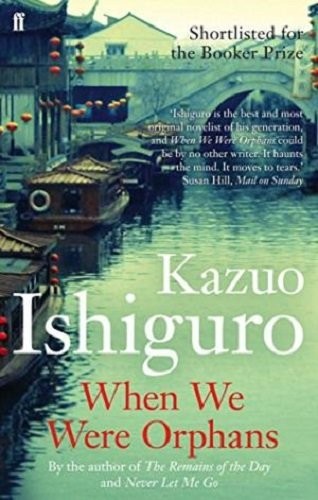
A celebrated detective in 1930s London, raised in the international settlement of Shanghai before his parents mysteriously vanished when he was a boy, returns to the city as war closes in, convinced that he can still find them and that solving their disappearance will somehow set the whole collapsing world right. Ishiguro writes in the voice of a narrator whose account cannot be trusted, and the pleasure and unease of the book come from watching the gap widen between his composed, rational surface and the increasingly deluded logic underneath. What begins as a period detective story slowly warps into a study of memory, denial, and the stories we tell ourselves to survive childhood loss, until the detective's certainty that his parents are still waiting somewhere becomes heartbreaking rather than plausible. This suits readers who value psychological subtlety, unreliable narration, and a novel that rewards attention to what the narrator refuses to see. It fits less well anyone wanting a satisfying whodunit, since the mystery matters far less than the mind trying to solve it. The surreal sequence in which he searches for his parents amid the actual bombing of Shanghai, treating a war zone like a case to be closed, is the book's most quietly devastating passage. Elegant, controlled, and deliberately disorienting, it works for readers who like their fiction oblique. Those expecting the emotional directness or clean resolution of a conventional detective novel will find it withholding by design, which is exactly its purpose.